
Lives and works in Shanghai and Jingdezhen.
1998 Born
2019-20 Central Saint Martins, the University of the Arts London, Program of Cultural Criticism and Curation (UK)
2022 B.F.A at The School of the Art Institute of Chicago (SAIC), Chicago, IL Emphasis on Sculpture (US)
Exhibitions
2025 “Fable Beneath the Monument”, Froots Gallery, Jingdezhen, China
2025 “Lusory Apophenia”, Absent Gallery, Guangzhou, China
2025 “The Living Room of Light”, Luohang Art Hill, Foshan, China
2025 “Traces of Becoming: The Contemporary Narrative of Intangible Heritage”, DOC Park, Guangzhou, China
2025 “Less Than One Square”, Froots Gallery, Jingdezhen, China
2024 “What if ‘Faileas’ Evaporate From Liquid”, Absent Gallery, Online
2024 “Constellation”, Newtown Castle, Ballyvaughan, Ireland
2021 “Don’t Mind the Thing”, Wedge Gallery, Chicago, USA
2021 “Dream Residue”, 33 E.Washington Gallery, Chicago, USA
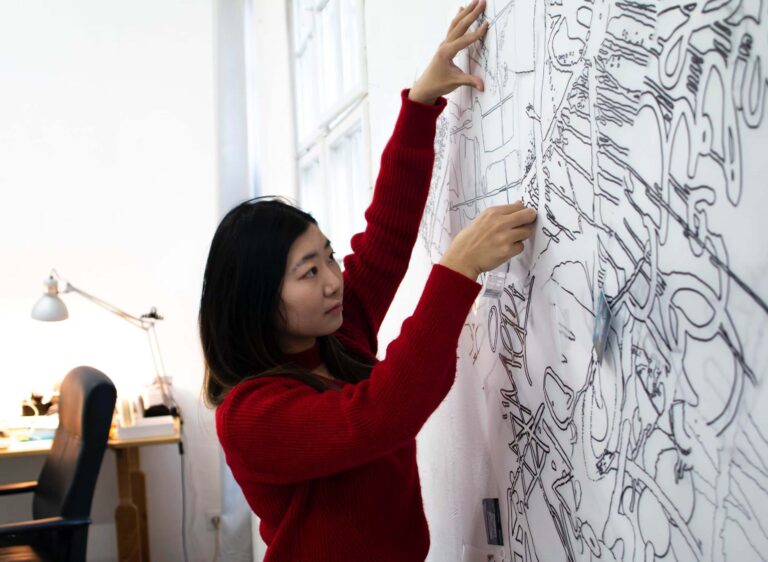
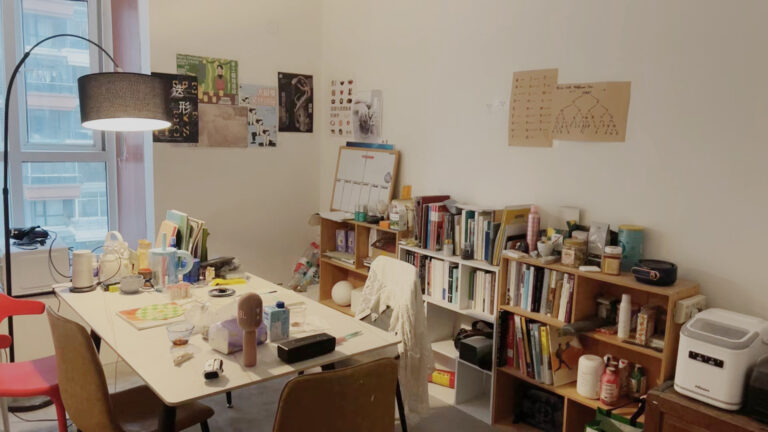
Judith Fang is a Shanghai-born installation artist whose work interlaces urban memory, celestial constancy, and the allegorical logic of games. Growing up amid the city’s rapid redevelopment, she witnessed the erasure of neighbourhoods and sought permanence in the unchanging patterns of the night sky. Her site-responsive installations merge tactile narratives—casting textures from endangered spaces, mapping stars in Braille—with the modular structures of puzzles and play. By inviting viewers to touch, rearrange, and navigate her works, Fang creates spaces where narrative is open-ended, resonating through shared acts of remembering, playing, and tracing meaning together.
White porcelain, Brass staples, Quartz-sand concrete, Silicone
Dimensions variable
Placelessness is an installation composed of modular white porcelain blocks, developed through a collaborative process of site-specific texture mapping in rural Huizhou. Working alongside local archaeological enthusiasts, I used silicone molds to systematically capture surface imprints from the decaying architectural remains of vernacular structures.
These imprints were then retranslated onto porcelain surfaces, forming a series of faux-historical building blocks. The work questions how “ancient towns” have become standardized, aestheticized templates within the broader logic of cultural tourism in contemporary China. The concept of placelessness, as introduced by human geographer Edward Relph, describes a condition in which spatial identity is eroded and replaced by homogenized visual codes. In many towns, the high cost of authentic restoration, combined with the commercial failure of preservation-based tourism, has led to a preference for demolition and facsimile reconstruction. Poured concrete and steel reinforcement become tools of architectural erasure—covering the organic irregularities of timber joinery and mortar with a seamless, inorganic finish. What once bore the marks of life, labor, and decay is now repackaged as a refined, performative simulation of history.
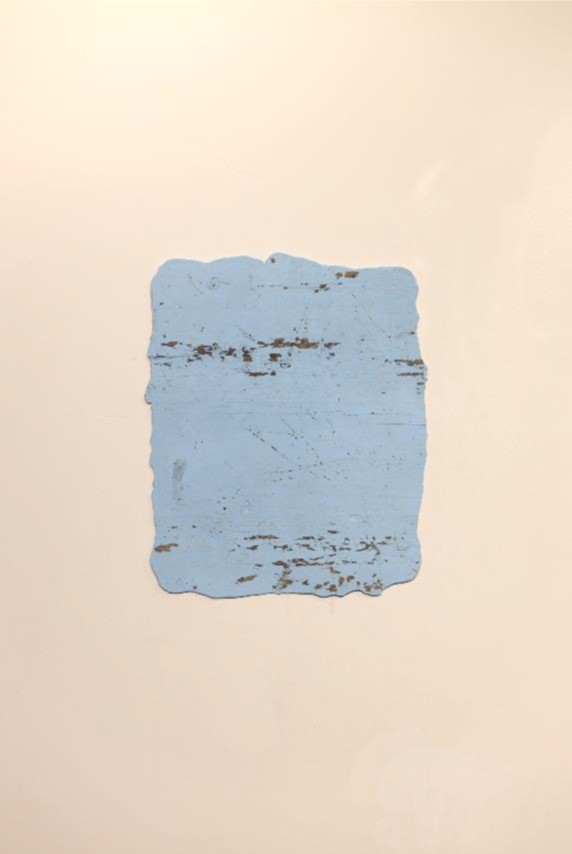
Wooden working desk from a traditional craftman’s studio-2024/05/13
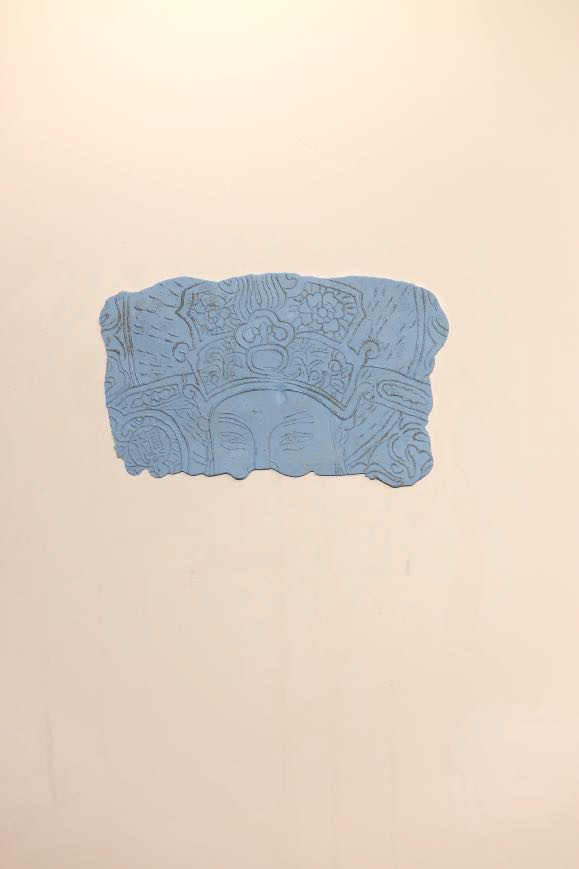
A face from San-Xing monument -2023/11/28
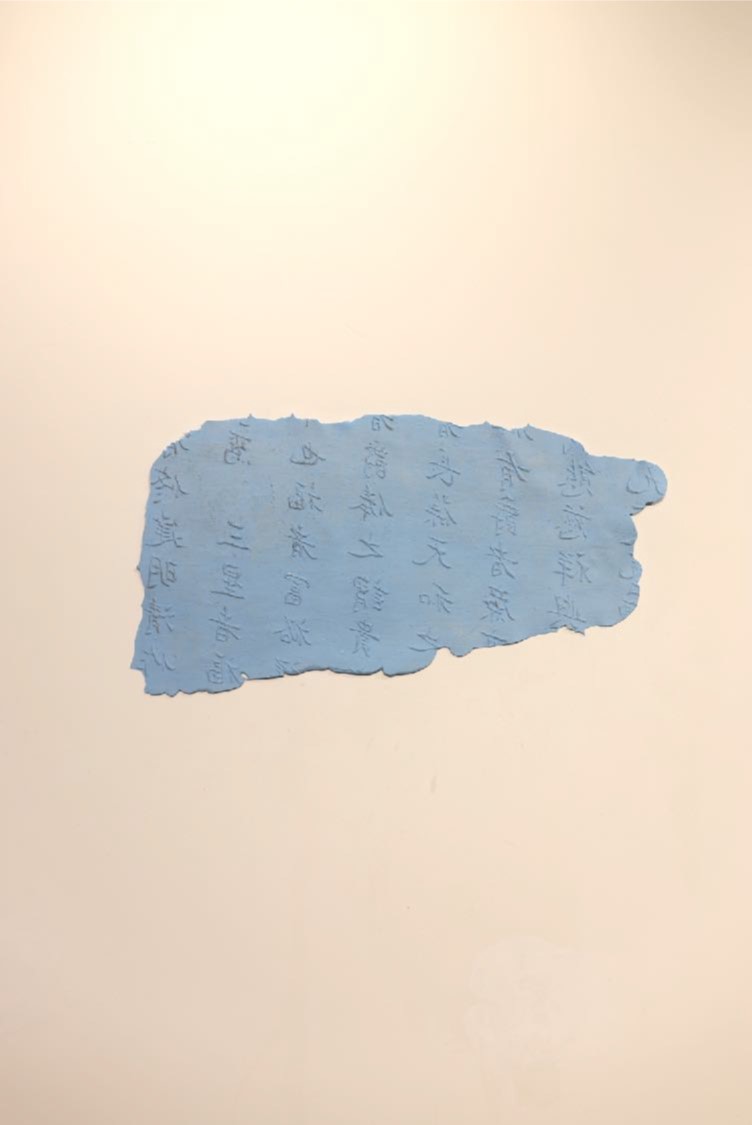
Partial text from San-Xing monument -2023/11/28
Porcelain, Silicone imprints, Mid-temperature transparent matte galze, Stain
Dimensions variable
Metal dots, UV pigments, Foil sticker
Dimensions variable
Constellation is a word search puzzle coded in braille, where each braille letter gently glows in the dark, mimicking the stars scattered unevenly across the night sky. Similar to a traditional word search, participants can find and decode the given words in braille by tracing the dots. Each attempt to connect the braille letters to a word reveals the essence of how constellations are formed: making sense of the chaotic natural world.
The chosen words represent the most common terms used to describe personality in astrology, shifting the focus from the stars themselves to their contemporary social meanings.